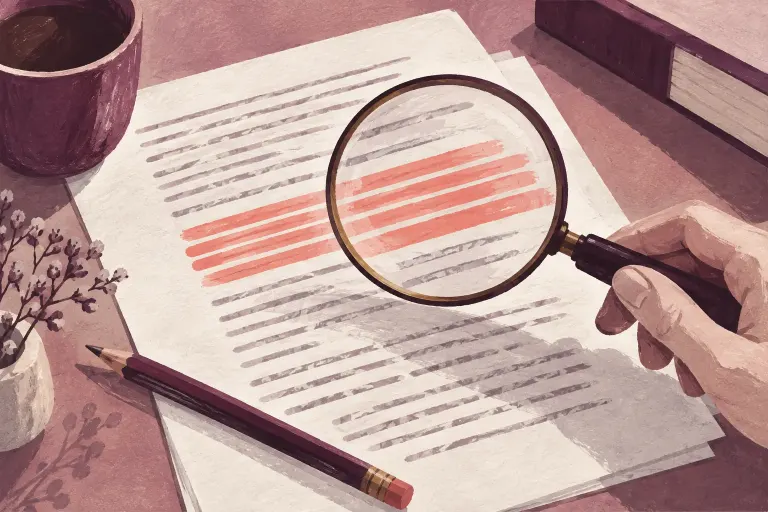
Second Look
A Scene Can Become Clearer When You Remove an Explanation
Test whether a scene already conveys what its explanatory sentence says. Compare two versions before deciding which information the reader needs.

Return to a piece with fresh questions about purpose, clarity and the experience of reading it.
Test whether a scene already conveys what its explanatory sentence says. Compare two versions before deciding which information the reader needs.
Use a list within prose deliberately by choosing an order, testing its final item, and cutting details that repeat the same job.
Find ambiguous pronouns in a draft by tracing who each sentence refers to, then make the smallest revision that restores clarity.
Test a working title against the draft’s actual question, example and ending so it attracts the right reader without promising a different article.
Support an abstract sentence with a relevant example, explain the connection, and keep illustrative details from turning into invented factual evidence.
Check narrative tense by identifying the main time frame and the purpose of each shift, rather than changing every verb to the same form mechanically.
Record major revision decisions in a few lines so you can compare versions, preserve useful experiments and avoid repeating changes that did not solve the problem.
Make prose leaner by identifying the action, removing repeated work and keeping qualifications that protect the meaning.